
Starting Over as a Virtual Assistant? You’re Not the Only One
(On losing clients, feeling left behind, and what it actually takes to start over as a virtual assistant)
There’s a specific kind of quiet that hits you when you lose a client. It doesn’t announce itself loudly. It just settles in, on slow Monday mornings, mid-scroll on LinkedIn, or whenever someone casually asks, “Kamusta ang work as a Virtual Assistant?” And you smile, because what else can you do?
That’s where I found myself recently. Two clients gone. A third one struggling. And if I’m being completely honest with myself, I wasn’t performing the way I used to. It’s a hard thing to sit with. But sitting with it was exactly what I needed to do.
I had become a struggling VA. And the first step to changing that was actually saying it out loud.
It’s a strange place to be in. And if you’ve been there too, or you’re there right now, this one’s for us.

How Did I Get Here?
The honest answer isn’t dramatic. It’s actually a very ordinary story, and I suspect a lot of freelancers know it intimately. Life got busy in the way that it does. New responsibilities, shifting priorities, seasons that quietly demanded more of you than you expected. Without meaning to, my freelance career moved to the back burner. Not abandoned — just… set aside.
The problem is, the industry never set itself aside. While I was doing something else, the field kept moving. New tools came out. Client expectations evolved. Skills that used to be a bonus became baseline requirements. And when I finally looked up and gave being a VA my full attention again, the gap was already there, wider than I realized, and impossible to ignore once I saw it.
No one warns you that freelancing requires constant tending. It’s not a career you can step away from and return to unchanged. The moment you stop learning, the distance grows — quietly at first, then all at once. I felt it. And being a work-from-home mom suddenly felt a lot less stable than it used to.
The Honest Check-In
Once you stop making excuses, you start asking real questions. What do I actually know? What’s still useful? Where have I genuinely fallen behind? What can I offer as a VA?
It’s not a comfortable exercise, but it’s the most useful one you can do.
For me, it looked like this: I had skills, but they were outdated. I had experience, but I hadn’t kept it fresh. I had a good foundation, but I had been riding on it instead of building on top of it.
Saying that clearly — not as a way to be hard on myself, but just as an honest look at where I was — made it something I could actually work with.
So, Where Do You Start?
If you’re in a similar spot, here are a few things that genuinely help:
- Do an honest skills check. Write down every service you offer. Then be real with yourself: which ones are you still confident about? Which ones haven’t you touched in a long time? Which ones do clients keep asking for that you can’t quite deliver yet? No judgment, just clarity.
- Pick one skill and go deep on it. When you feel behind, it’s tempting to try learning five things at once. That usually leads to learning none of them well. Pick one skill that’s in demand, one you have a bit of background in already, and really dig into it. Doing one thing well will do more for your confidence (and your profile) than dabbling in several.
- Put yourself out there before you feel fully ready. A lot of people wait until everything is polished before they update their portfolio or reach out to clients again. But clients can’t find you if you’re invisible. Even if the work is still in progress, personal projects, things you’ve been practicing, share it. People respond to growth, not just finished products.
- Reconnect with people, no pitch needed. You don’t have to come back with a sales message. Reach out to former clients or fellow freelancers just to catch up, let them know you’re actively working again, and stay visible. Most new opportunities come from people who already know you not from cold applications.
- Give yourself a real plan, not just a vague goal. “I’ll do better” is a wish. A simple 90-day plan on what you’re learning, how many hours a week, or what you’re working toward turns that wish into something you can actually follow. Even on slow or discouraging days, having something concrete to check off keeps you moving.
The Skills You Set Aside Aren’t Gone
Here’s the part I want to linger on for a second, because it’s easy to miss.
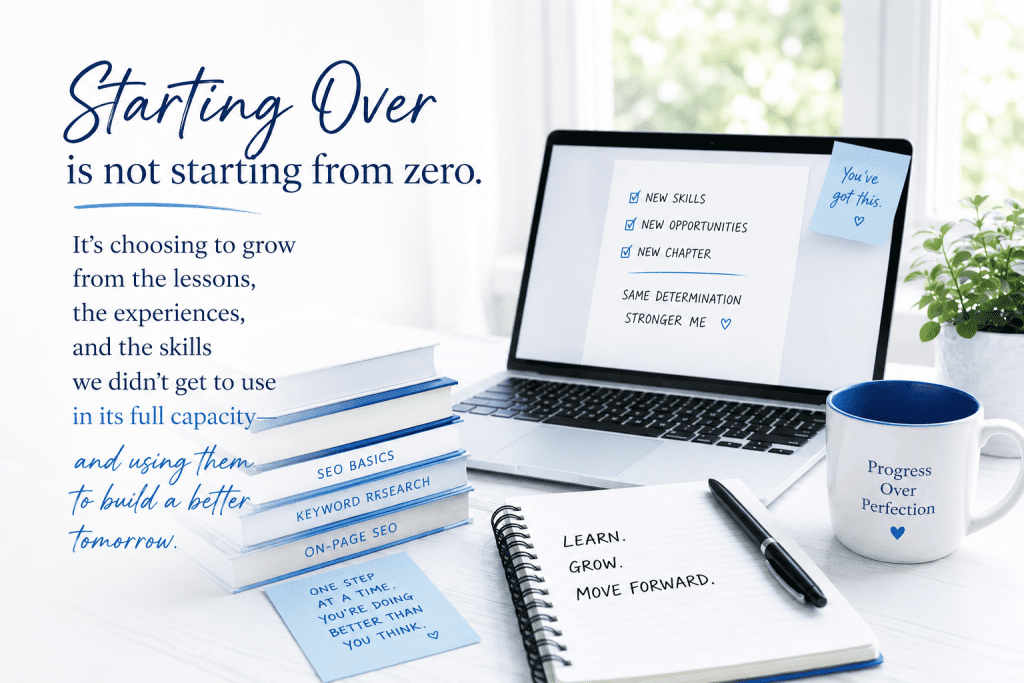
Most of us who feel behind aren’t starting from zero. We have real skills — things we studied, practiced, believed in — that we just didn’t get to fully use before life interrupted. And that can feel like a specific kind of loss, not the loss of never trying, but the loss of almost getting there.
But those skills didn’t disappear. They’ve been waiting.
And here’s what’s worth remembering: the version of you that comes back to those skills isn’t the same person who first learned them. You’re older. You’ve been through more. You understand things about yourself and about work that you didn’t before. That changes how you’ll use what you already know.
It wasn’t wasted. It was just waiting for me to come back and take it further.
Starting Over Is Not Failing
There is nothing wrong with rebuilding. Some of the best virtual assistant out there have gone through seasons where they lost clients, lost momentum, or lost confidence. What made the difference wasn’t that they avoided those rough patches — it’s that they didn’t let the rough patch become the final chapter.
You’re allowed to start over. More than once, even.
So if you’re in that season right now, feeling a little behind, a little uncertain, wondering if you’ve missed your window, I want to tell you clearly: you haven’t. The gap is closeable. The skills are learnable. And the foundation you already have, even if it feels dusty, is still worth something.
Pick up where you left off. Start with one thing. Take it one step at a time.
You’ve already done the hardest part, you showed up again.


You May Also Like
Jonah Chipeco: From Freelance Moonlighting to Asia’s Writerpreneur
Rakuboss.ph: A New Skills Marketplace for Freelancers